Should we really be afraid of robots?
In recent years, automation and robotics have become central topics in both media discussions and business strategies. As technology continues to evolve, more and more people are asking a very direct question:
will robots take jobs away from humans?
These concerns are understandable. On one hand, we see rapid advancements in warehouse robotics, automation systems, and artificial intelligence. On the other, companies are increasingly focused on cost optimization and operational efficiency.
But does this really mean the end of human work in warehouses?
Where does the fear come from?
Fear of technological change is nothing new. Every industrial revolution has triggered similar concerns.
Moreover, media coverage often focuses on the most advanced and visually striking technologies — humanoid robots, fully automated warehouses, and autonomous systems operating with minimal human involvement.
As a result, it creates a vision of a future where humans are no longer needed.
In reality, however, the situation is far more nuanced.
The reality: robots do not replace humans one-to-one
Contrary to popular belief, warehouse robots rarely replace human workers directly.
Instead, they:
- take over repetitive and physically demanding tasks
- support workers in their daily operations
- improve speed, accuracy, and consistency
At the same time, many processes still require flexibility, decision-making, and experience — qualities that machines cannot yet fully replicate.
This means that automation does not eliminate jobs, but rather transforms them.
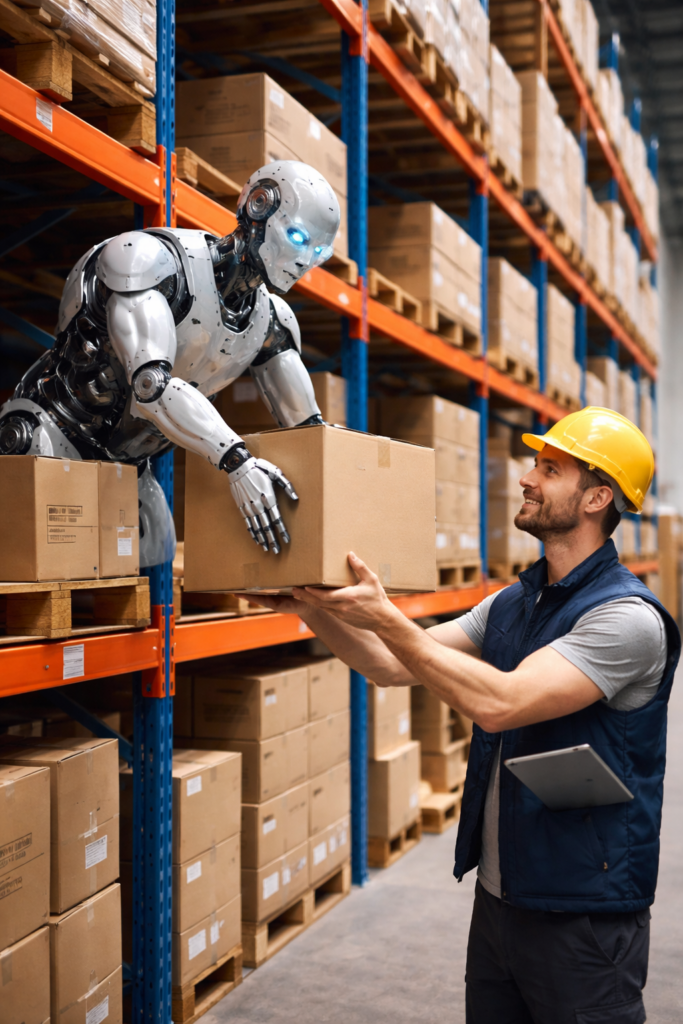
How is warehouse work changing?
Automation is not removing work — it is reshaping it.
In practice, this means:
- less physically demanding labor
- more roles related to system supervision and coordination
- growing demand for technical skills
Additionally, workers increasingly collaborate with robots rather than being replaced by them.
The warehouse of the future is a collaborative environment where humans and machines work side by side.
It is also important to look at automation from a business perspective, especially when it comes to costs and investment decisions
How Much Does Warehouse Automation Cost in 2026? Real Costs, Examples, and ROI
Who benefits from automation?
Despite common concerns, automation can create value for both businesses and employees.
Companies benefit from:
- higher efficiency
- reduced error rates
- improved process predictability
Employees, on the other hand, often experience:
- less physically exhausting work
- opportunities to develop new, technical skills
- more structured and organized work environments
In many cases, this shift is beneficial for both sides.
Are there risks?
Of course, automation is not without its challenges.
In some cases, it may lead to the reduction of certain roles — particularly those that are highly repetitive.
However, at the same time, new roles are emerging, such as:
- system operators
- robotics maintenance technicians
- automation specialists
The key challenge is adapting skills to the evolving job market.
Conclusion: transformation, not replacement
Warehouse robots are not a threat in the simplest sense of the word.
They do not represent массов replacement of human workers, but rather a gradual transformation of how work is performed.
This is not the end of human work — it is the beginning of a new model of collaboration between people and technology.
In the long term, the biggest challenge will not be automation itself, but the ability to adapt — both for companies and for employees.
If you want to understand the most common mistakes companies make when implementing robotics, check out this article
Biggest Mistakes When Implementing Warehouse Robots (and How to Avoid Them)