Why is e-commerce increasingly interested in robots?
E-commerce is growing rapidly, and customer expectations are growing with it. Orders need to be processed quickly, accurately, and preferably on the same day. For many online stores, this creates increasing pressure on warehouse operations.
In practice, the warehouse often determines whether a company can handle sales growth. If order picking takes too long, mistakes, delays, and dissatisfied customers quickly appear. That is why more and more companies are asking one important question:
can warehouse robots in e-commerce really improve efficiency and reduce costs?
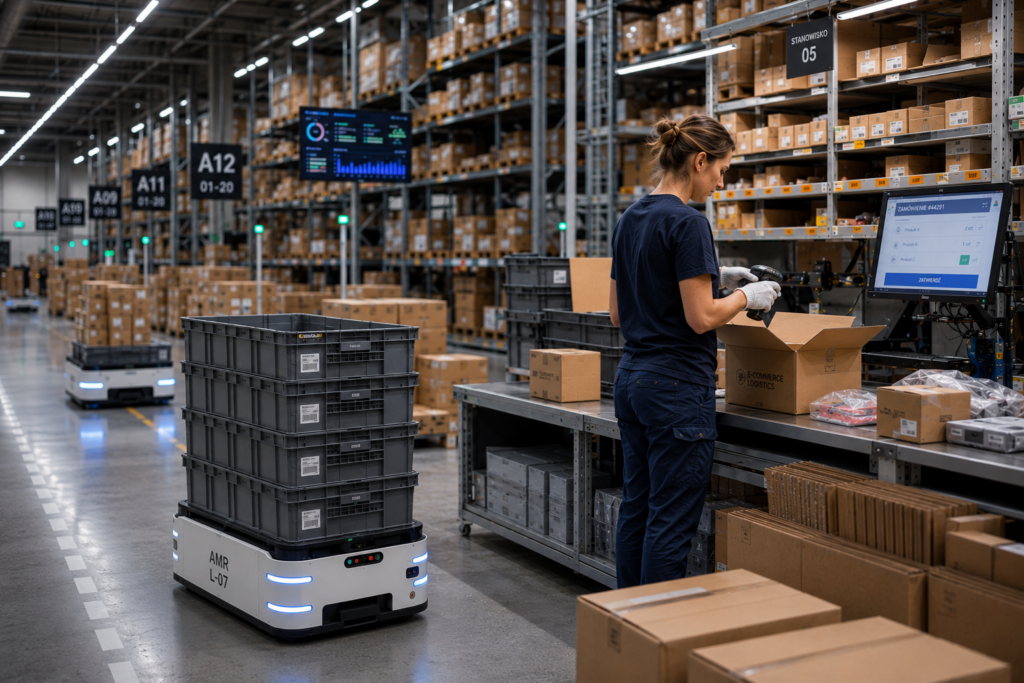
Where can robots help in an online store warehouse?
Warehouse robots do not always mean a fully automated logistics center. In many cases, their role is much more practical.
In e-commerce, robots can support:
- transporting product bins,
- delivering goods to picking stations,
- reducing walking distances for employees,
- handling repetitive order processes,
- supporting operations during peak seasons, such as before holidays.
Robots bring the most value where workers spend a lot of time walking around the warehouse. If a robot can deliver a product or container to a workstation, the whole process becomes faster and more predictable.
AGV or AMR — which is better for e-commerce?
In e-commerce warehouses, companies usually consider two main types of robots: AGV and AMR.
AGV robots move along fixed routes. They work well in stable environments where processes are predictable and the warehouse layout rarely changes.
AMR robots are more flexible. They can move autonomously, avoid obstacles, and adjust their route in real time. That is why in dynamic e-commerce environments, AMR robots are often the more practical solution.
If you want to better understand the difference between these technologies, see also:
How do warehouse robots work? AGV vs AMR – simple and practical
When does order picking automation make the most sense?
Warehouse robots in e-commerce are most profitable when a company has already reached a certain operational scale.
Automation may make sense when:
- the number of orders is growing regularly,
- order picking is taking more and more time,
- employees walk long distances across the warehouse,
- picking errors occur frequently,
- the company experiences seasonal sales peaks,
- warehouse processes are repetitive.
In these conditions, robots can help increase efficiency without increasing employment at the same pace. This is especially important in e-commerce, where sales can grow quickly and manual processes may start limiting business development.
What benefits can robotics bring to e-commerce?
Well-implemented warehouse robots can bring several practical benefits.
First, they reduce order picking time. Employees do not need to constantly walk across the warehouse because part of the internal transport is handled by robots.
Second, they reduce the number of errors. When the system guides the process step by step, it is easier to avoid selecting the wrong product.
Third, they help use employees more effectively. Instead of spending time walking between shelves, workers can focus on picking, quality control, and packing.
Fourth, robots make business scaling easier. As order volume grows, the company can gradually add more robots or workstations instead of rebuilding the entire warehouse immediately.
You can read more about potential savings here:
How much can you save with warehouse robotics?
When may robots in e-commerce not be worth it?
Automation is not always the right choice. For small online stores, robots may be too expensive compared to the real operational needs.
Robotics may not make sense when:
- the number of orders is low,
- the warehouse operates in a very simple model,
- products are unusual or difficult to automate,
- processes change frequently,
- the company does not yet have stable sales volume.
In such cases, it is better to first organize warehouse processes, improve layout, and implement simpler tools, such as a better WMS system or clearer picking zones.
Only after that should the company consider robots.
The most common mistake: automating chaos
One of the biggest mistakes in e-commerce is trying to automate poorly organized processes.
If the warehouse is chaotic, product locations are outdated, employees use their own methods, and the system does not show correct stock levels, robots will not solve the problem.
They may even make it worse.
Automation works best when a company already has solid foundations:
- a logical warehouse layout,
- accurate product data,
- a repeatable picking process,
- clearly described locations,
- clear packing and shipping rules.
If you want to prepare your company for such an implementation, see also:
How to prepare a warehouse for automation? 7 key steps
How much can e-commerce automation cost?
The cost of implementation depends on warehouse size, number of robots, system type, and the level of integration with existing software.
Small implementations may include individual robots supporting internal transport. Larger projects may require WMS integration, process redesign, and the creation of several picking stations.
That is why it is not enough to look only at the price of the robot. Companies should also consider:
- process analysis,
- system integration,
- employee training,
- service,
- maintenance,
- possible downtime during implementation.
You can read more about costs in this article:
How much does warehouse automation cost in 2026? Real costs, examples and ROI
Conclusions
Warehouse robots in e-commerce can significantly increase efficiency, reduce errors, and make business scaling easier. However, they are not a magic solution for every online store.
They make the most sense where a company handles a large or rapidly growing number of orders, processes are repetitive, and the warehouse is becoming a limitation for further growth.
In practice, companies should first organize their processes, analyze costs, and identify which areas truly require automation. Only then should they choose a specific technology.
The most important question is not:
are robots in e-commerce modern?
but rather:
do they solve a specific business problem in this warehouse?
If the answer is yes, order picking automation may become one of the most important steps in the development of an online store.