Why is warehouse preparation so important?
Warehouse automation can significantly increase efficiency, reduce errors and improve work organization. Today, warehouse robots, transport systems, AMR, AGV and intelligent software are increasingly used in logistics, manufacturing and e-commerce companies.
However, simply buying robots does not solve warehouse problems.
If processes are chaotic, data is outdated, product locations are not organized and employees follow different rules, automation may not deliver the expected results. In some cases, it can even increase costs and make daily operations more complicated.
That is why the most important question is:
How to prepare a warehouse for automation so the investment makes sense?
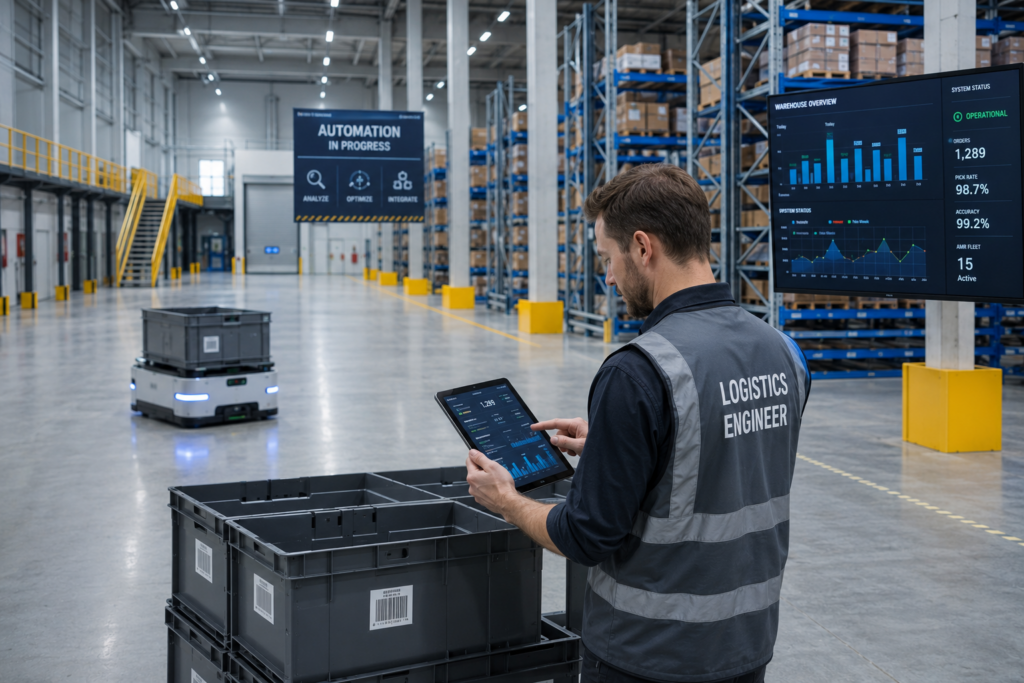
Step 1: Understand your current warehouse processes
The first step is not choosing a robot or contacting a technology supplier. First, you need to understand exactly how your warehouse works today.
It is worth analyzing:
- how goods receiving works,
- where delays occur,
- how long order picking takes,
- how far employees walk during a shift,
- where errors appear most often,
- which processes are repetitive,
- which tasks create the biggest workload for the team.
Automation makes the most sense where processes are repetitive. If the process looks different every day, implementing robots becomes more difficult and less predictable.
Before automation, it is worth carrying out a simple operational audit. It does not need to be very complex at the beginning. A good first step is to identify which tasks take the most time and which problems appear most often.
Step 2: Organize data and product locations
Robots and automation systems need good data. If system data is incorrect, even the best technology will perform poorly.
Before implementing automation, companies should check:
- whether product locations are up to date,
- whether inventory levels match reality,
- whether products have clear identifiers,
- whether the WMS or ERP system shows correct information,
- whether employees follow the same rules for labeling goods.
Poor data quality is one of the most common reasons why automation projects struggle. A robot can move a bin, but if the system points to the wrong product location, the entire process will still generate errors.
In practice, automation does not fix bad data. It uses it.
That is why, before implementing robots, companies should organize product databases, locations, names, codes and basic rules for working with the warehouse system.
Step 3: Identify which processes are really worth automating
Not every warehouse process needs to be automated. This is very important.
A common mistake is trying to automate everything at once. In practice, this leads to high costs, a complex project and difficulties in measuring results.
At the beginning, it is better to choose one or two processes that have the biggest impact on efficiency.
Automation is most often considered in areas such as:
- internal transport,
- order picking,
- delivering bins to workstations,
- sorting,
- replenishment,
- returns handling,
- moving products to packing areas.
A good candidate for automation is a process that is repetitive, time-consuming and easy to measure. If a company can clearly say: “this is where we lose the most time”, that is usually the right place to look for the first use of robots.
If you are interested in AMR robots in these processes, read also:
AMR in Warehouse: How Autonomous Mobile Robots Improve Logistics Operations
Step 4: Define the business goal of the implementation
Automation should solve a specific problem. It should not be implemented only because it looks modern.
Before starting a project, it is worth answering a few questions:
- do we want to shorten order picking time?
- do we want to reduce the number of errors?
- do we want to reduce the distance walked by employees?
- do we want to increase warehouse throughput?
- do we want to handle seasonal order peaks better?
- do we want to reduce operating costs?
Without a clearly defined goal, it is difficult to evaluate whether automation was successful.
A well-defined goal may sound like this:
“We want to reduce order picking time by 30% within 12 months.”
Or:
“We want to reduce picking errors and improve shipping punctuality.”
Such a goal makes it possible to measure results and discuss automation in business terms, not only technological ones.
Step 5: Choose technology only after process analysis
Technology selection should be the result of analysis, not the starting point.
Only when a company knows what problem it wants to solve should it decide whether AGV robots, AMR robots, transport systems, automated storage solutions or simpler organizational improvements are the best option.
AGV robots work well where routes are fixed, the environment is predictable and processes are highly repetitive.
By contrast, AMR robots are more flexible. They perform better in dynamic warehouses where layouts change, obstacles appear and people work alongside machines.
If you want to better understand the difference between these technologies, read:
How do warehouse robots work? AGV vs AMR – simple and practical
The most important rule is simple:
process first, technology second.
Step 6: Calculate the real cost of automation
The cost of warehouse automation is not only the price of the robot.
The full budget should include:
- purchase of robots or automation systems,
- software,
- integration with WMS or ERP,
- process analysis,
- employee training,
- service,
- maintenance,
- possible downtime during implementation,
- system development in the following years.
Many companies make the mistake of looking only at the cost of equipment. In practice, integration, configuration and maintenance can have a major impact on the total project cost.
Before making a decision, it is worth preparing a realistic budget and comparing it with the expected benefits.
You can read more about costs here:
How Much Does Warehouse Automation Cost in 2026? Prices, Examples, and ROI
Step 7: Start with a pilot project
The safest way to implement automation is to start with a pilot project.
Instead of automating the entire warehouse immediately, it is better to choose one area and test the solution in real conditions.
A pilot project allows companies to:
- test the technology in daily operations,
- evaluate employee reactions,
- measure results,
- identify problems,
- reduce risk,
- prepare better for full implementation.
A well-planned pilot gives the company real data. It shows whether robots actually reduce work time, limit errors or improve throughput.
If the results are positive, the system can be scaled gradually.
However, when the results are weak, the company can improve the process or change the approach before investing more money.
The most common mistake: automating chaos
The biggest mistake is not the lack of automation. The biggest mistake is automating chaos.
If the warehouse is poorly organized, robots will not solve every problem. They may only speed up a process that is already working badly.
Before implementation, it is worth making sure that the company has:
- organized locations,
- up-to-date data,
- clear picking rules,
- repetitive processes,
- a prepared team,
- a defined business goal,
- a realistic budget.
Otherwise, automation may become an expensive addition to a poorly functioning system.
If you want to avoid such problems, read also:
Biggest Mistakes When Implementing Warehouse Robots and How to Avoid Them
Should every warehouse automate its processes?
No. Automation is not the right solution for every warehouse.
Small companies, unstable processes, low order volumes or very unusual products can make robotics difficult to justify financially.
Sometimes a better first step is:
- improving work organization,
- better labeling of locations,
- implementing a simple WMS,
- changing the warehouse layout,
- training employees,
- standardizing processes.
Only when the basics are organized does automation start to make more sense.
Warehouse robots work best where the company has enough scale, repeatability and a clearly defined problem to solve.
Conclusions
Preparing a warehouse for automation is just as important as the technology itself. Robots, transport systems and intelligent software can bring major benefits, but only when the company knows what it wants to achieve.
First, companies need to understand their processes, organize data, choose the right area for automation and define a business goal. After that, it makes sense to compare technologies and discuss costs.
A well-prepared warehouse has a better chance of successful implementation, faster ROI and real efficiency improvement.
The most important question is not:
should we buy robots?
But rather:
is the warehouse ready for automation?
FAQ: How to prepare a warehouse for automation
Where should warehouse automation preparation start?
It should start with an analysis of current processes. Companies need to identify where delays occur, which tasks are repetitive and which problems limit warehouse efficiency the most.
Can warehouse robots fix a poorly working process?
No. Robots can improve a well-defined process, but they rarely fix organizational chaos. Before automation, companies should organize data, product locations and work rules.
What should be prepared before implementing robots?
Before implementing robots, companies should prepare accurate warehouse data, a logical location structure, described processes, a business goal, a budget and a pilot plan.
Is warehouse automation always profitable?
No. Automation is most profitable where processes are repetitive, the scale of operations is large enough and the company has a clear problem to solve.
Why is it worth starting with a pilot project?
A pilot project allows companies to test technology in real conditions, measure results, reduce risk and prepare better for full implementation.