New EU regulations will reshape how machines are designed and implemented. Find out what this means for businesses and warehouse automation.
Industry 4.0 Is Here — and So Are New Regulations
Industry 4.0 is no longer a vision of the future — it has become a reality. As a result, regulations are evolving alongside technological progress.
On January 20, 2027, the current Machinery Directive (2006/42/EC) will be replaced by the new EU Machinery Regulation 2023/1230. Importantly, this is not just a name change, but a fundamental update to safety standards in the digital era.
Experts, including TÜV Rheinland, clearly indicate that these new regulations will elevate industrial standards. In particular, they focus on cybersecurity, artificial intelligence (AI), and advanced human–robot collaboration.
Why the Shift to a “Regulation” Matters
The key difference is that a regulation applies directly and uniformly across all EU countries. Therefore, it eliminates inconsistencies in national interpretations, which is crucial when implementing modern systems.
It is also worth understanding how warehouse robots work — see:
how warehouse robots work (AGV vs AMR)
It is important to note that all these solutions will now be subject to stricter certification requirements.
Cybersecurity: Protecting Machines in the Digital World
In an increasingly connected environment, traditional physical safety is no longer sufficient. Therefore, the new regulation requires manufacturers to protect control systems against unauthorized access.
Additionally, systems must be resilient to cyberattacks, and any software changes affecting safety must be properly documented and traceable.
Artificial Intelligence (AI) and Autonomy
The European Union introduces stricter oversight for machines with high levels of autonomy. In particular, if a system uses machine learning algorithms, the manufacturer must prove that self-learning processes do not lead to unsafe situations.
That is why understanding ROI is equally important — see:
how much you can save with warehouse automation
Human–Robot Collaboration (Cobots)
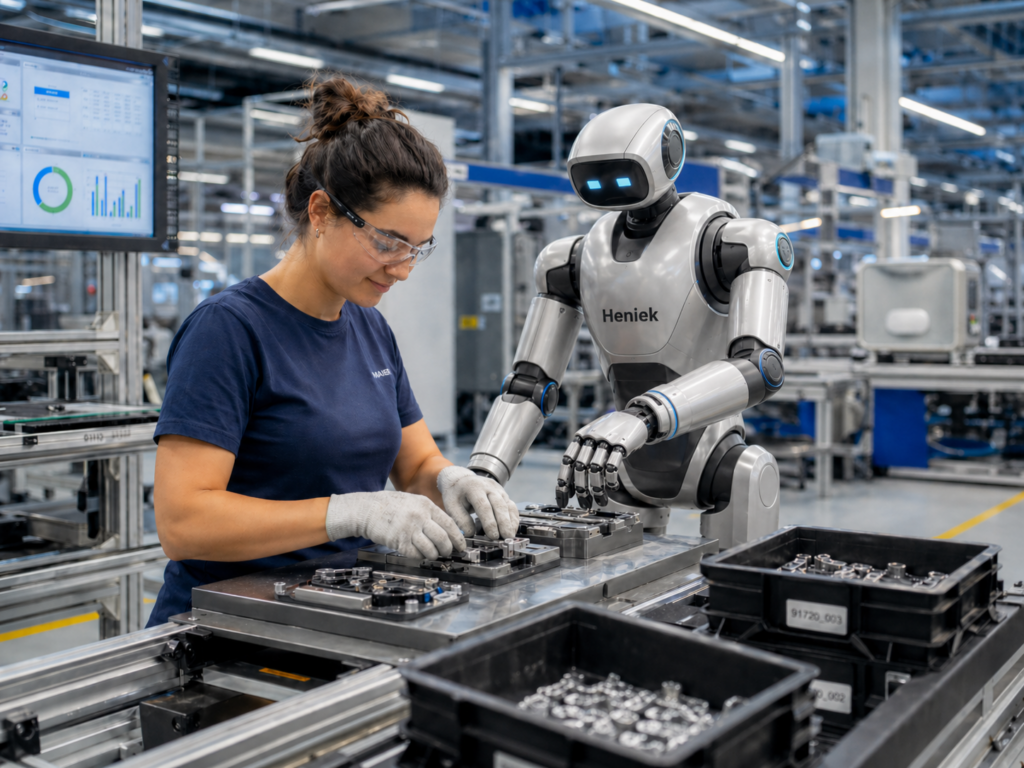
In the area of collaborative robotics, the regulation places strong emphasis on ergonomics. Specifically, systems must be designed to minimize operator stress and ensure a safe and comfortable working environment.
High-Risk Machines: New Requirements
Machines classified as high-risk will now require mandatory certification by a notified body. As a result, manufacturers will no longer be able to self-declare compliance in many cases, significantly raising quality and safety standards.
How to Prepare
Although January 2027 may seem distant, the development cycle of modern systems takes months — if not years. Therefore, companies should act now:
- Regularly audit projects against new digital and safety requirements.
- Prepare for digital documentation (e.g., QR code-based instructions).
As a result, the new regulation should be seen not only as a challenge, but also as an opportunity to build safer and more efficient automation systems.
Conclusion
The EU Machinery Regulation 2023/1230 is not just a legal update. Therefore, companies should treat it as a strategic element rather than a formal obligation.
In practice, this means integrating cybersecurity, AI, and human–robot collaboration already at the design stage. Moreover, organizations that begin preparations early can gain a real competitive advantage.
On the other hand, delaying action may lead not only to higher costs, but also to implementation delays and certification challenges.
The earlier a company starts preparing, the greater the competitive advantage it can build.